
Here’s a personal anecdote to get things started…
A few days after my final interview with an up-and-coming startup, the hiring manager called me with news that I had passed (nice!). I barely had a moment to do a little celebratory jump when the conversation moved on to compensation. He shared the salary and then said “we can also offer you 35,000 options at a $2 strike price”. Uh…
I did not know what any of that meant. I think I just coughed awkwardly and said, “oh, cool, that sounds pretty good?” Silence on the other end of the phone. Not my proudest moment. But also, when and how was I supposed to have learned this stuff? Was 35,000 a lot? Was a $2 strike price good?? I had no frame of reference and I didn’t know what to ask (or whether I should be asking questions at all).
So let me spare you from any kind of similar future experience
Today we’re talking about employee stock options, which are slightly different from regular exchange-traded options (those things called “calls” and “puts”). We’ll cover what they are, how they work, and some essential considerations around taxes and timing. Cool? Cool.
What is an employee stock option? And why is it called that?
When a company grants you employee stock options, they are giving you the right to buy company stock at a specified price (known as a “strike price”), within a certain time period. It’s called an option because you don’t HAVE to buy the stock (you have the right, but not the obligation). Most options will “vest” (i.e. become available to be purchased) on a multi-year schedule — this is not unlike the vesting schedule we covered in my post on RSUs.
Once the option has vested, you have the right to “exercise” your option and buy the stock. If the value of the stock has risen above your strike price, you’re essentially buying company stock at a discount. And in some cases, the discount is huge and the proceeds are life-changing.
So, to recap the terms I just introduced (plus a few extras)…
- The grant date is when the options are given to the recipient (or “optionee” – a word that sounds funny to me)
- The strike price is the pre-determined price at which you can purchase company stock
- The vesting schedule is the timeline over which increments of options become available to be exercised
- When you exercise an option, you are purchasing the company stock at the strike price
- Options must be exercised prior to their expiration date, otherwise, they expire worthless and are absorbed back into the company (usually 10 years after the options are granted)
- The bargain element (think of this as the “discount”) is the difference between the strike price and the fair market value of the stock on the date that you exercise the option (“fair market value” is easier to ascertain when the company is public — when the company is private, you have to rely on the company’s most recent valuation).
Just so we’re totally clear…
When your options are vested and you decide that you’d like to exercise them, you have to purchase the shares. With money. You can purchase them as they vest or all in one go once you’re fully vested. This consideration boils down to how long you want to stay at the company, how confident you are in the likelihood of an exit (IPO or acquisition), and how much you’re willing to fork out in taxes before getting your payday.
So if I had 35,000 options at a $2 strike price and they were all vested (assuming I hung around for 4 years), I would need to come up with $70,000 to purchase those shares. But if, for example, the company had just IPO’d and the stock price was now $20… well I’d do my darndest to come up with that money. Because not exercising the options would mean leaving $630,000* in potential earnings on the table… before taxes (there it is).
(*Math: 35,000 * $20 = $700,000 minus the $70,000 I have to pay to purchase the shares equals $630,000 in potential earnings before taxes, IF I sold the shares immediately)
Let’s zip through tax treatment and then I’m gonna take a nap
Okay, “zipping” might be an overstatement, we’re going to slowly jog through tax treatment (it’ll be like when you see someone “jogging” and you’re like, I could walk faster than that).
Setting the stage
Your company has given you stock options. Nice. You’re vested. Also nice. Now you’re thinking about exercising those options and wondering, “what’s my tax bill going to look like?”
How exercised options get taxed depends on three things
- Do you have “non-qualified stock options” or “incentive stock options”?
- What is the bargain element? (i.e. how big of a discount are you getting between the strike price and the fair market value?)
- Are you selling or holding once you’ve purchased the stock?
Non-Qualified vs. Incentive
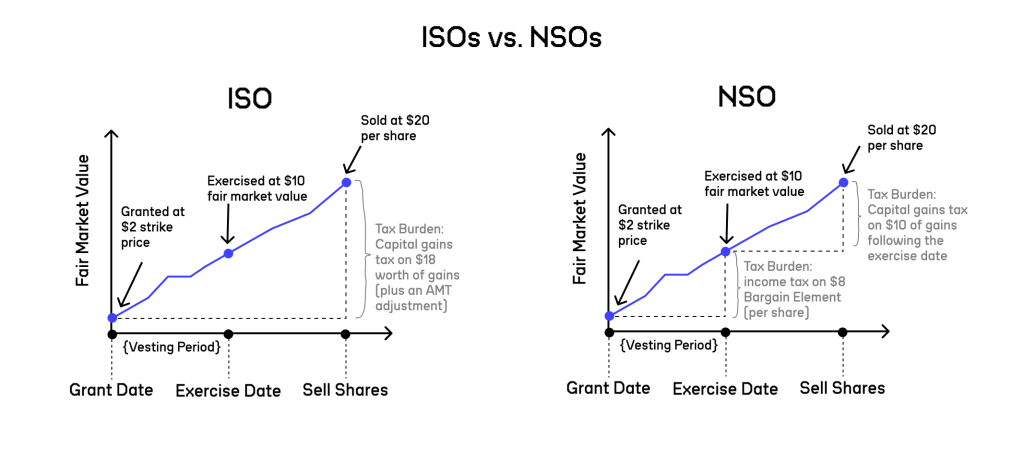
Incentive stock options (ISOs) get better tax treatment because you only pay taxes once. With ISOs, you pay taxes when the shares are sold (which would happen sometime after the options are exercised and the shares purchased).
There is a catch: ISOs can lose their special status if they’re sold less than one year after the option has been exercised AND less than 2 years after the original grant date. Another catch: your ISOs may kick you into a situation where you’re required to pay an “Alternative Minimum Tax” adjustment. In a nutshell, AMT was created by Congress in 1969 to make sure super-rich people didn’t entirely escape taxes with special deductions and credits — it didn’t age well, due to the fact that it wasn’t indexed to inflation until 2015.
I had to pick my battles in this article and I choose to skimp on an AMT explanation. A deep dive (written by me) can be found here.
With non-qualified stock options (NSOs), you get hit with a one-two punch: when you exercise the option (i.e. purchase the shares) the bargain element gets taxed as income immediately, and then, when you sell those shares, additional gains are subject to capital gains tax (short or long term, depending on how long you hold).
Bargain element
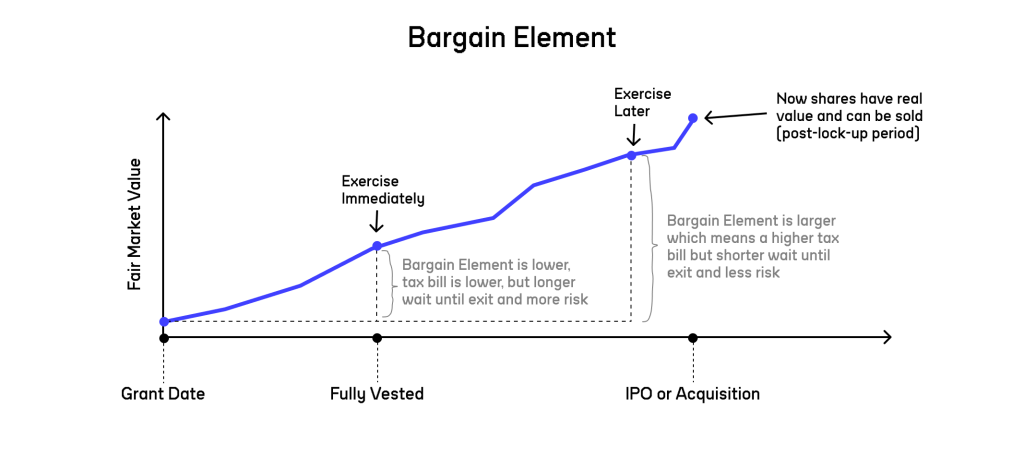
The bargain element, the spread, the discount… all saying the same thing: at the time you exercise the option, how much upside is there to be taxed? This is more relevant to folks with NSOs because you HAVE to pay income taxes on this amount right away.
Something worth considering is whether the company has or has not yet IPO’d. If they’re public, yes, you’ll pay taxes, but you’ll also own shares that have real market value. If your company is not yet public, exercising the option can stick you with a fat tax bill and potentially nothing of value down the line if they never go public or never get acquired. BUT, the fair market value is probably lower pre-IPO, so your tax bill would be lower too.
Hold the shares vs. sell immediately
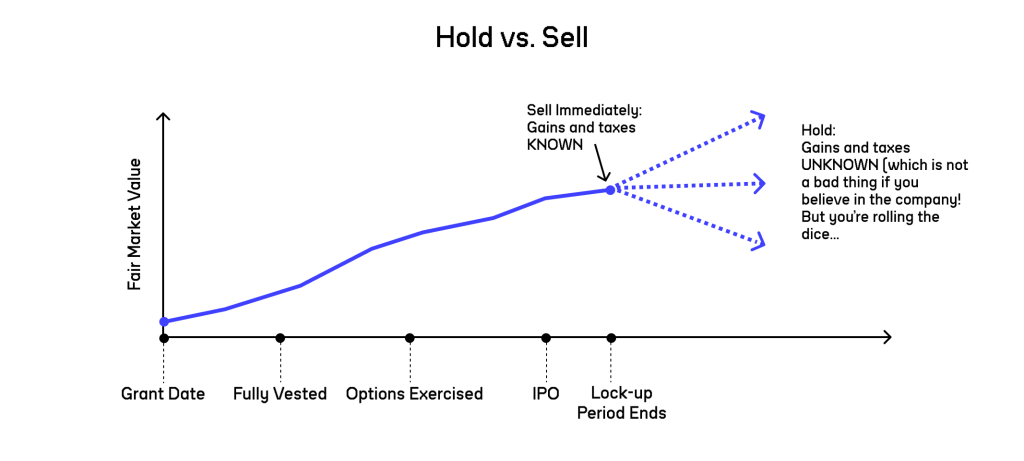
If the company is pre-IPO, you don’t have the option to sell your shares unless you go through a third-party service like EquityZen. If the company just IPO’d, you’re likely subject to a 90-180 day lock-up period where you can’t sell either.
In the case that you can sell immediately (the company is public, out of lock-up period range, vested, and ready to exercise), selling immediately means you’ll only pay taxes on the bargain element because there wouldn’t be additional capital gains.
Holding means rolling the dice on the future value of your shares — they could go up or down. Up means capital gains tax, down means you’re losing money. Holding is also a lot harder to justify with NSOs because you HAVE to pay taxes upfront. So, passing up on the opportunity to sell immediately means you’re stuck with a big tax bill and, if your company’s stock price goes down, you left money on the table. Nobody said these decisions were easy.
If you are certain that your company is going public
A common strategy is exercising your options 6 months before IPO and working with a dedicated equity lending service to cover the tax bill (SecFi does this sorta thing).
Wrapping up my scenario…
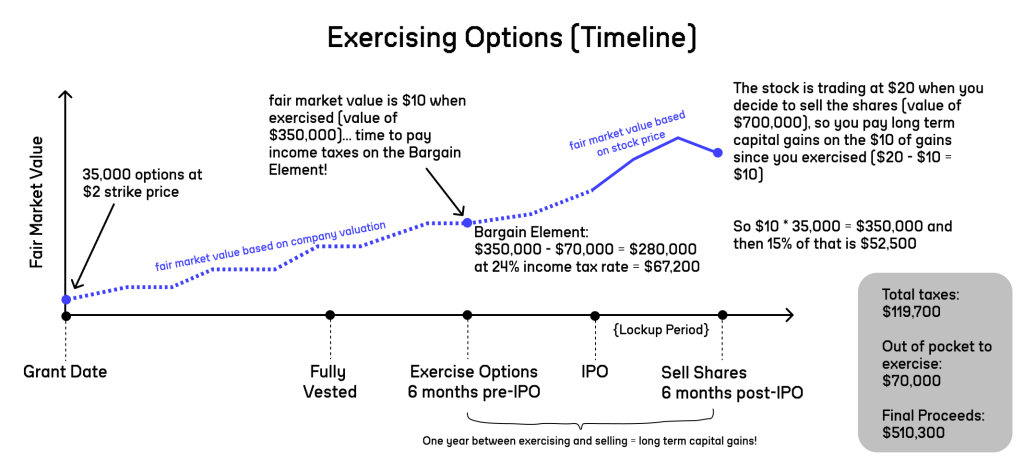
Let’s say I took the job offer, worked at the company until all my options were vested, and then one day the CEO told employees we were going public in 6 months and that the fair market value of the shares was currently $10, but would likely jump up to $20 after our IPO (I realize this is getting very specific, the scenarios to explore here are truly endless)
If I exercised my options NOW (let’s assume my options are NSOs) I’d be stuck paying income tax on a bargain element of $280,000 ($350,000 – $70,000). Which, if I were in the 24% bracket, amounts to a bill of approximately $67,200.
We IPO and I decide to sell my shares after the 6 month lockup period. Now, if the shares had held around the $20 price point as our CEO had predicted, the value of my shares would now be $700,000 (holy smokes).
However, since the shares had risen from $10 to $20, I’d also have to pay capital gains tax on another $350,000 of gains. Fortunately, I’d only be paying the 15% long-term capital gains rate, because it would’ve been a year since I exercised the options…but that’s still another $52,500 in taxes.
Long story short, my total tax bill would be $119,700… but in the grand scheme, I’d be $510,300 richer (don’t forget the $70k in cash that I originally needed to shell out to exercise the options). And maybe only ~$500k richer if I needed to get an equity loan to cover the initial purchase. That’s more than a 600% return on investment. Yeehaw.
How about an image to make that a bit more palatable?
Excuse the clearly non-linear timeline on the x-axis…
Final comments: are employee stock options worth it?
For plenty of early-stage companies, options are often the majority of the compensation… and it’s not uncommon for the options to end up worthless (if you’ve followed the WeWork saga, you’d know that there are a LOT of pissed off employees). But that’s an inherent risk with startups. When they do come to fruition, either with an IPO or a big acquisition, the upside can be massive (just be ready to front a big tax bill).
Ultimately, assessing the risk of exercising pre-IPO (lower tax bill, less certainty, higher potential upside) or post IPO (higher tax bill, immediate value, but potentially less upside) is not easy to do. This is one of those instances where a financial advisor familiar with equity can play a very important role.
There are a lot of scenarios we didn’t explore here, but I hope that you now have a foundation to dive a bit deeper into the instances that are most relevant to your situation.
Thanks for reading
Nothing in this essay is investment, legal, or tax advice. It’s a general discussion of concepts I find useful in my work and shouldn’t be relied on as a recommendation for your specific situation. Talk to a qualified advisor (ideally one who knows you) before acting on anything here.