
As much as you’d like to put your previous employer behind you and focus solely on your new gig, a midyear job change generates a lengthy to-do list for anyone making over $250k.
I have a client who switched jobs over the summer. We ran through more than thirty items across multiple categories before it felt like we’d checked all the boxes.
There are obvious considerations, like rolling your old 401(k) into your new plan, assuming the investment options are decent. And then there’s a lot of less obvious stuff.
A new employer is genuinely good at the basics
The plan menu is clear, the deadlines are spelled out, HR walks you through direct deposit and a 401(k) rate and answers your questions throughout that jam-packed “onboarding day.”
But you didn’t start the year (or fiscal calendar) there.
You’re arriving with six months of income and benefits from another employer already on the books. Your Social Security withholding starts over. Your household can cross tax thresholds that neither employer withheld for. How much you can still put into a 401(k) depends on what you already put into the last one.
The onboarding packet assumes a clean January-to-December year at one company.
What follows is the rundown, across taxes, retirement contributions, health coverage, insurance, and equity.
1. Each employer withholds as if it’s your only job
Payroll systems don’t know about each other.
Each employer withholds taxes as though the wages it pays are the only wages you earn all year. In a single-employer year that’s fine, but with two, a few things get funky.
Social Security withholding resets to zero
Each employer withholds 6.2% up to its own wage-base cap, which is $184,500 in 2026.
Change jobs midyear and the new employer starts your Social Security withholding at zero, with no idea you already paid in at the old one. If your combined wages clear the cap, you over-withhold.
This isn’t the end of the world; it isn’t lost money. The excess comes back as a credit when you file in April. But you’re floating that amount to the government until then, which means, if you were expecting to free up some cash in the back half of the year when you crossed the withholding threshold… that isn’t gonna happen.
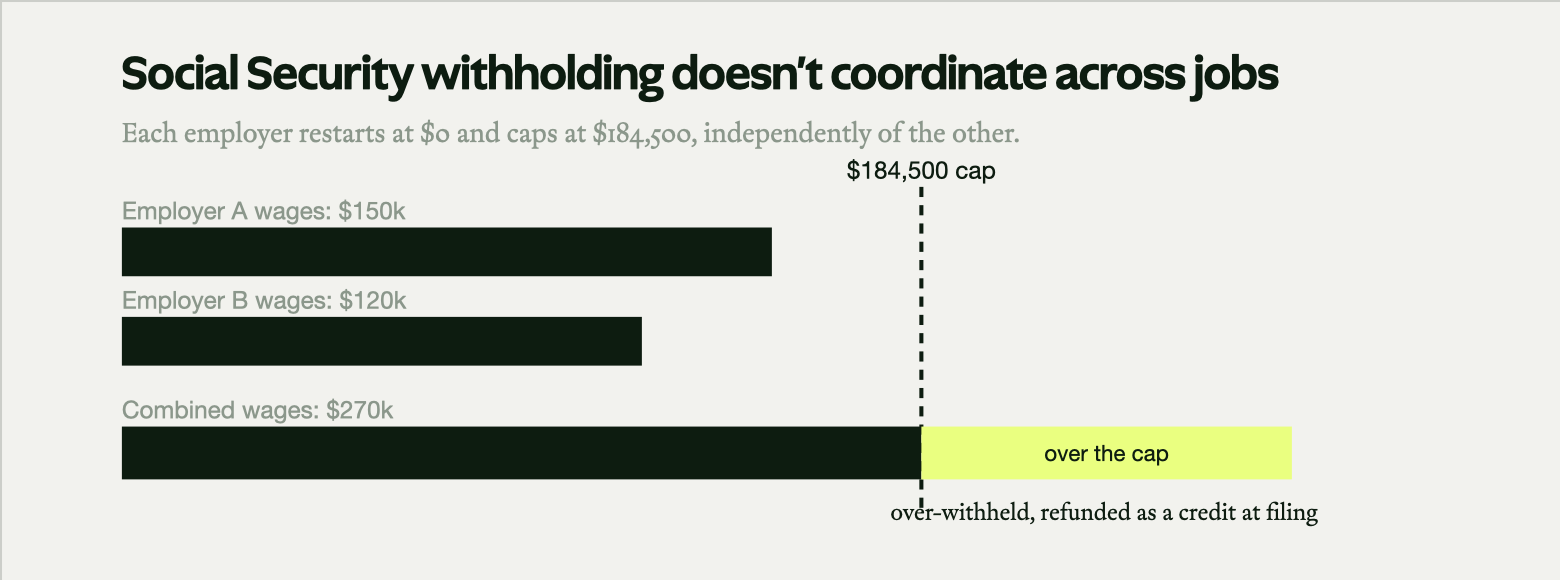 Each employer restarts your withholding at $0 and caps at $184,500 on its own. Earn past the cap across both jobs and you pay Social Security twice on the overlap, then recover it as a credit at filing.
The Medicare surtax can slip through entirely
There’s a 0.9% surtax on wages above $200,000. Each employer only starts withholding it once the wages it pays you cross $200,000.
It doesn’t know your spouse’s income. It doesn’t know your household files jointly at a $250,000 threshold.
So a dual-income couple can owe the surtax while neither employer withheld a dollar of it. That’s a balance due at filing that lands as a surprise if you aren’t expecting it.
Now, is it likely that the 0.9% is going to be subject to penalties? That’s the part where it might be worth calculating your safe harbor in advance. You might be in the clear, but penalties suck and no one should be paying them.
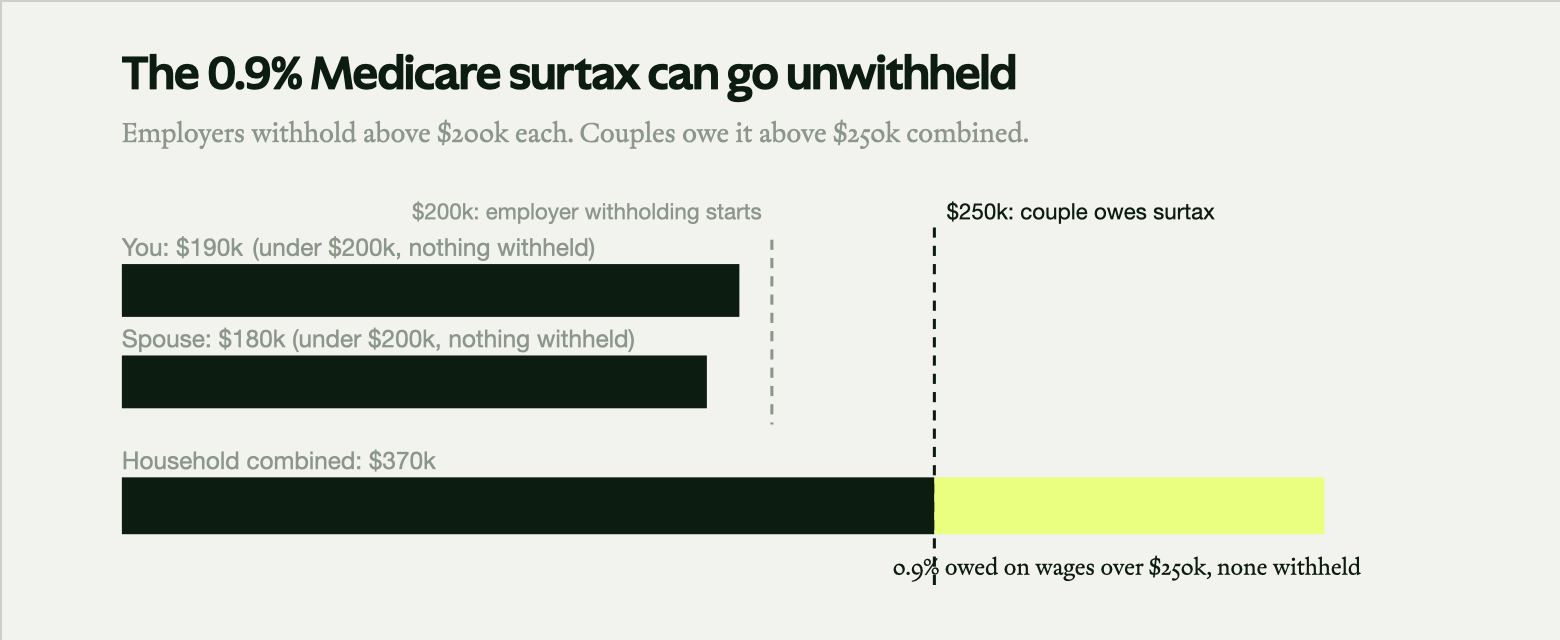 Each spouse earns under $200k, so neither employer withholds the surtax. The household still clears $250k combined, so the 0.9% is owed on the wages above that line, with nothing set aside for it.
Two W-4s make the projection hard
The annual tax projection gets more difficult in a transition year. Two W-4s, two withholding rates, a prorated salary at each stop, and potentially multiple bonuses.
If you made estimated payments last year, the amounts you set up almost certainly don’t fit the new income picture anymore.
Lean on the safe harbor
There’s a clean fallback when the year is too messy to project: the prior-year safe harbor.
If you can’t pin down what you’ll owe, paying in 110% of last year’s total tax (the threshold for higher earners) keeps you clear of the underpayment penalty, regardless of how this year shakes out.
If you can project it—you know both salaries and the bonus—pay at least 90% of the actual number. (You will have to pay your full tax burden come tax time, but you won’t be hit with penalties).
2. 401(k) contribution limits: an opportunity (or trap)
A 401(k) has two separate limits, and they behave differently when you switch employers midyear.
The deferral limit follows you; the 415 limit resets
The first limit is the elective deferral, the salary you personally defer, which is $24,500 in 2026.
That one is per person, across every employer in the year. Your new plan has no idea what you deferred at the old one, so tracking the total is on you. Defer $20,000 at the first job and you have $4,500 of room left at the second, not a fresh $24,500.
The second is the Section 415 limit: the total of everything that goes into a single plan (your deferrals, the match, and any after-tax contributions), which is $72,000 in 2026. That one is per employer.
And that’s where a midyear switch can open something up.
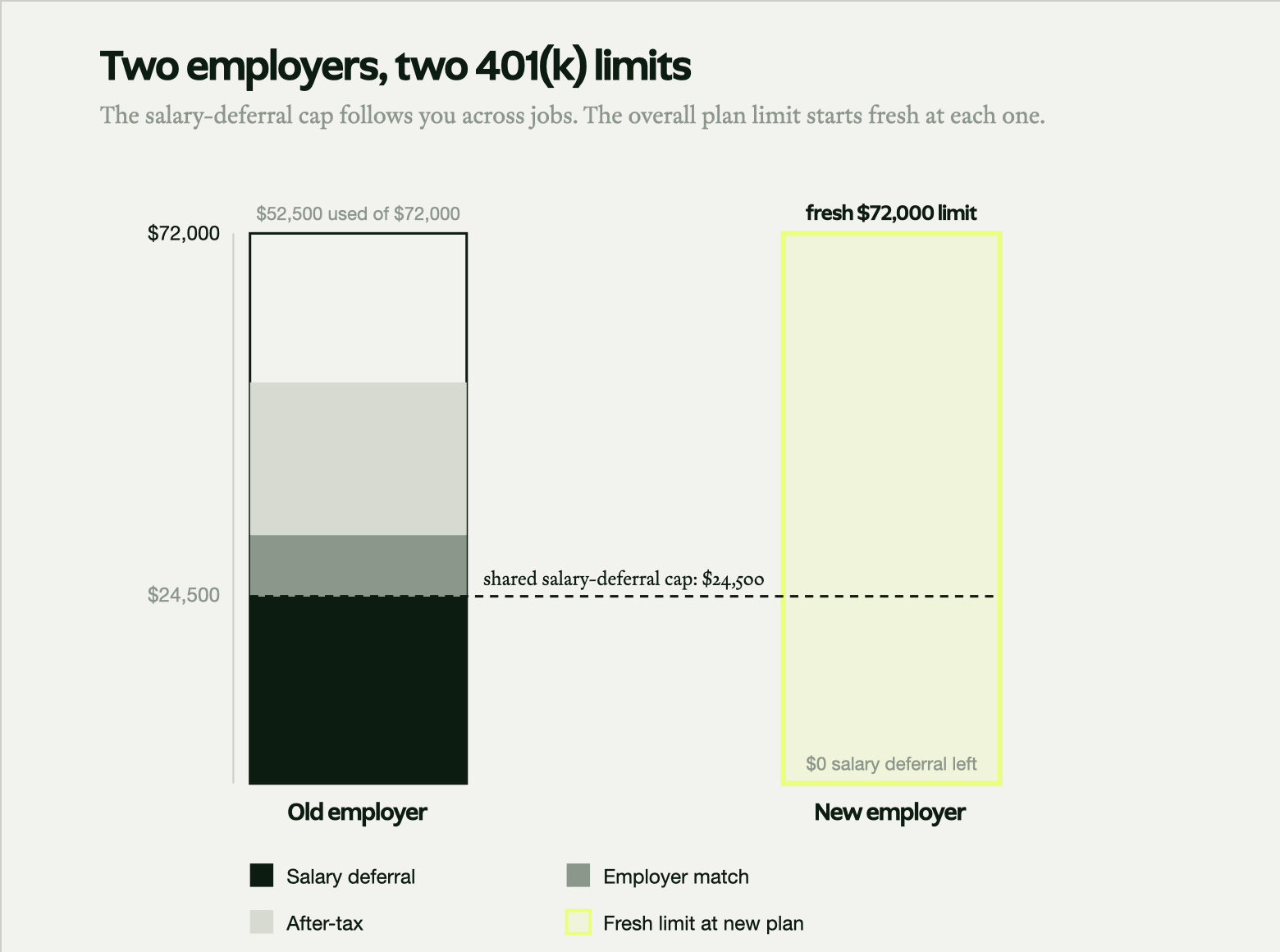 Old plan: you’ve filled $52,500 of its $72,000 limit. New plan: your salary deferrals are used up for the year, but the $72,000 limit resets, so match and after-tax dollars start fresh.
Say at your old employer you’d already deferred the full $24,500, picked up $8,000 in match, and put $20,000 into the plan’s after-tax bucket. That’s $52,500 counted against that plan’s $72,000 limit.
Then you leave.
At the new employer, your elective deferrals for the year are done. The $24,500 followed you. But the new plan has its own separate $72,000 limit, so after-tax contributions there can run toward a fresh $72,000, even though you can’t defer another dollar of salary.
In a two-employer year, your after-tax (mega backdoor Roth) capacity can be significantly larger because each employer has its own Section 415 limit.
If the new plan supports after-tax contributions and in-plan conversions, that’s a window worth using, assuming your cash flow needs are covered.
Confirm the new match!
Match formulas vary by plan.
The rate you have to contribute to capture the full match at the new job may not be the rate you ran at the old one. Set your deferral too low and you leave a match on the table; set it on the old formula and you may mis-size it.
Inspect the auto-enrollment default
Many plans auto-enroll you around 3%, usually well below what you intend to save.
What percentage you elect for the remainder of the year should consider the dollars contributed to-date against the deferral limit. If your salary is different at the new job, or if there’s a waiting period, some calculations may be required.
If there’s a waiting period, model the catch-up
Some plans make you wait three to six months before you can contribute or receive a match.
That’s months of deferral room you’ll need to make up in a compressed window if you still want to hit the annual limit. Which means a higher deferral rate for the rest of the year, and a smaller paycheck while you do it.
Run those numbers—it might mean dipping into savings to cover an income gap, but catching up to $24,500 of deduction at your income level could be well worth it.
Think twice before rolling the old 401(k) into an IRA
The tempting move is to roll the old balance straight into a traditional IRA—if it’s in an IRA, you control how the funds are invested (and could maybe choose some funds with better expense ratios).
Before you do, think about the backdoor Roth. A pre-tax balance sitting in a traditional IRA triggers the pro-rata rule, which makes future backdoor Roth conversions partly taxable.
If the new 401(k) accepts rollovers and has decent investment options, rolling the old balance into the new plan instead keeps your IRA clean and your backdoor Roth path open.
After-tax dollars can move to a Roth IRA tax-free
If the old plan held after-tax contributions, there’s a nice piece of housekeeping available.
The after-tax basis can roll to a Roth IRA tax-free. You already paid tax on those dollars, so they land in the Roth with no additional tax. The earnings would go to a traditional IRA to stay deferred.
It’s cleanest when you move the whole after-tax sub-account at once. Most people don’t realize this is on the table.
3. With both spouses employed, the HSA has to be coordinated across two plans
When both of you have access to an employer high-deductible plan, keeping each spouse on their own can come out ahead of putting the whole family on one.
Two plans can mean two employer HSA contributions and, sometimes, lower combined premiums.
One caveat: an HDHP has to be the right fit for how your family actually uses healthcare. If your needs point to a richer plan, the HSA perks don’t rescue it. (And kids only stay on their current network if they’re already on the non-job-changing spouse’s plan, so check before assuming nothing changes for them.)
The family limit is shared across both accounts
The family HSA limit is $8,750 in 2026. That’s the ceiling across both spouses’ accounts combined, not per account.
Employer contributions count toward it too, which is the part that’s easy to leave out of the tally.
Add up what both employers are putting in and what both of you are contributing before you set your payroll elections. Otherwise you can sail past the limit without noticing.
Overshooting isn’t free
Excess HSA contributions draw a 6% excise tax for every year the extra money sits in the account.
You can undo it by pulling the excess (and any earnings on it) out before your tax-filing deadline. But that’s a cleanup you’d rather skip. Easier to track both plans as you go than to unwind it in April.
4. Your old coverage doesn’t come with you, and the new elections lock in for the year
Insurance is the category people click through fastest during onboarding (it’s all defaults and fine print) and the one they most regret skimming. Several of the choices are one-time and hard to reverse.
Group life usually doesn’t travel
Employer group life generally ends when you leave.
Many plans let you convert it to an individual policy, and some let you keep the group coverage by porting it. Both come with short windows, often 30 to 60 days from your separation date.
If you want to hold onto any of that coverage, basic or supplemental, check what the old plan allows before the window closes.
Size life insurance off total comp, not base
If your income is base plus bonus plus equity, insuring only the base can leave you covered for a fraction of what the household actually lives on.
For a lot of high earners the gap is two to three times larger than they’d guess.
The disability tax election (pay now or later)
Many employers let you choose whether to pay your long-term disability premium with pre-tax or after-tax dollars.
Pay pre-tax and the premium is cheaper now, but any benefit you collect later is taxable. Pay after-tax and you give up the small break now in exchange for a benefit that comes to you tax-free at the moment you’d most need it.
The election is usually set at enrollment and locked for the plan year.
Read the fine print on the coverage itself
A few disability details shape how much protection you actually have.
The elimination period, meaning how long you’d wait before benefits start, ranges from 90 days to 52 weeks. That’s the stretch you’d self-fund out of savings, and 90 days versus a full year is a very different amount of cash to have on hand.
Group LTD usually caps out on base salary and ignores bonus and equity. For someone whose comp is heavily variable, that can leave 30% to 50% of income uninsured. Often the exact case an individual policy exists to fill.
Check whether the coverage is “own-occupation” or “any-occupation.” Own-occ pays if you can’t do your specific job; any-occ only pays if you can’t do any job you’re reasonably suited for. For a specialized or senior role, that distinction is most of the policy’s value.
And if you’re comparing group coverage against an individual policy, compare them net, not gross. The group benefit is taxable if the employer paid it or the employee paid it pre-tax. An individual policy you funded yourself pays tax-free. Subtracting one gross number from the other overstates your coverage.
5. A job change is a natural time to check your concentration in company stock
If equity is part of your comp, changing jobs is a clean checkpoint to address how much of your net worth is tied to a single company’s stock. And how much concentration you WANT in your new company. I’d suggest setting a target then sticking to a “sell and reinvest elsewhere” on new shares (RSUs, ESPP) that land in your account once you’ve reached your target.
New employer, new trading rules
If you’re joining a publicly traded company, expect blackout windows and (potentially) pre-clearance requirements on the new company’s stock.
Confirm the trading rules before you build any plan around buying or selling on your own schedule. Most companies automate these blackout periods inside of the brokerage account.
6. Beneficiary designations don’t move with you
Your old 401(k) beneficiary election doesn’t populate the new plan. New life and disability policies frequently start with the field blank.
Set the beneficiary on the new 401(k) and on any new coverage while you’re already in the paperwork. While you’re at it, re-check the beneficiaries on your IRAs and existing policies too.
Beneficiary designations override your will… don’t let this minor administrative check-up snowball into something bigger than it needs to be.
Where this leaves you
Individually, these aren’t complicated.
But during a midyear job change, they arrive at once, several items have deadlines, and no one at your new company is walking over to your desk asking, “hey are you sure you adjusted your 401(k) election to address the 3-month delay?”
Your old employer is done with you. The new one is set up to onboard employees as if they were starting fresh in January. Working around the half-year of income and coverage you’re carrying between them is entirely on you.
Or you and your financial advisor.
These are conversations we have with clients at Stoneholt. Calculating the withholding, the contribution limits, the coverage elections, and the equity, and making the calls while the windows are still open.
We’re a fee-only planning firm for high-income millennial families whose lives have gotten more complicated than their account balances suggest; equity comp, side income, child education funding, aging parents, coordinating a kitchen remodel, etc.
If you just changed jobs, or you’re about to, that’s a good time to start a conversation.
This article is educational and general in nature. It is not individualized investment, tax, or legal advice. Consult a qualified professional about your specific circumstances.